
Shop
Museum
Overview
Exhibitions


Collections
Education
Publications
Clark Connects
Art on the Grounds
Study Center
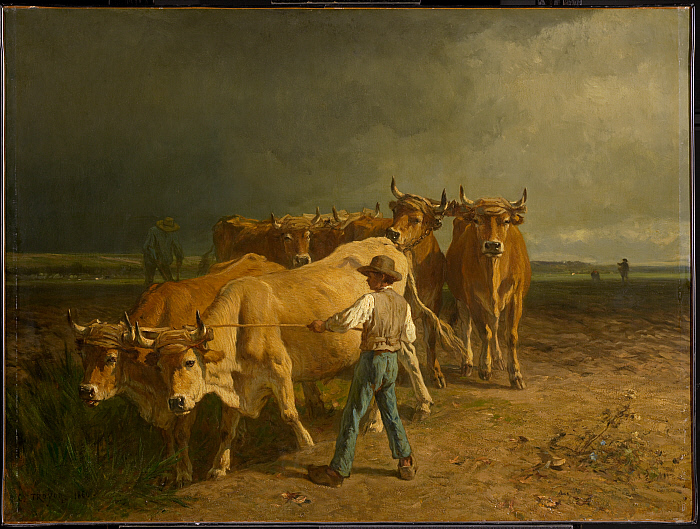
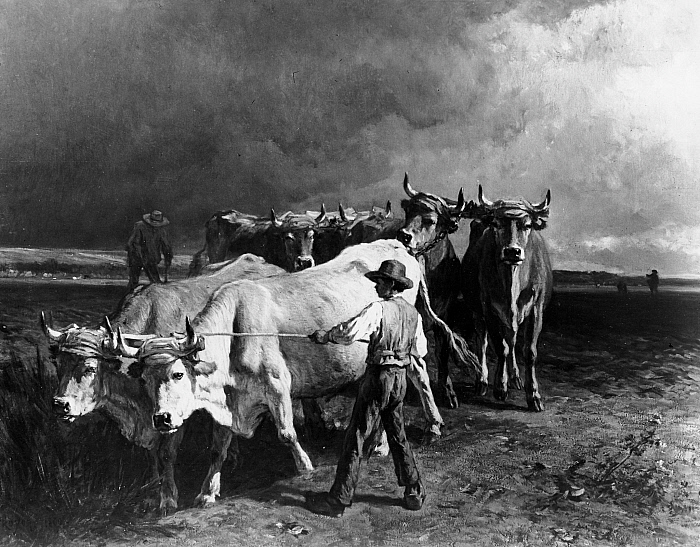
Image Not Available




Zoom
Download
JPEG images are suitable for most presentation uses. TIFF images are suitable for publication purposes. When using images, please reproduce caption and credit information. For details or further information, click here.
If the file does not immediately download, it should open in a new tab. Once opened, right–click the image to save.
Audio
Constant Troyon
French, 1810–1865
Oxen Plowing
1860
Troyon’s painting shows a young plowman steering six large oxen ahead of a gathering storm. This work is a scaled-down version of a much larger painting that earned lavish praise when the artist exhibited it at the Universal Exposition of 1855 in Paris. Prolific and adept at disseminating his work, Troyon had a long and successful career as a painter of country scenes.
Image Caption
Constant Troyon, Oxen Plowing, 1860, oil on canvas. Clark Art Institute, 1955.56
Medium
oil on canvas
Dimensions
38 1/4 x 51 1/8 in. (97.2 x 129.8 cm)
Object Number
1955.56
Acquisition
Acquired by Sterling and Francine Clark before 1955
Status
Off View
Select Bibliography
Champlin, J. H., Jr., ed. Cyclopedia of Painters and Paintings. New York: Charles Scribner's Sons, 1886. Sterling and Francine Clark Art Institute. Exhibit Four: First Two Rooms. Exhibition catalogue. Williamstown, MA: Sterling and Francine Clark Art Institute, 1955. Sterling and Francine Clark Art Institute. List of Paintings in the Sterling and Francine Clark Art Institute. Williamstown, MA: Sterling and Francine Clark Art Institute, 1970. Sterling and Francine Clark Art Institute. List of Paintings in the Sterling & Francine Clark Art Institute. Williamstown, MA: Sterling and Francine Clark Art Institute, 1972. Boime, Albert. "The Case of Rosa Bonheur: Why Should a Woman Want to be More Like a Man?". Art History, 4:4. (Dec. 1981).:pp. 384-409. Sterling and Francine Clark Art Institute. List of Paintings in the Sterling and Francine Clark Art Institute. Williamstown, MA: Sterling and Francine Clark Art Institute, 1984. Kern, Steven, ed. List of Paintings in the Sterling and Francine Clark Art Institute. Williamstown, MA: Sterling and Francine Clark Art Institute, 1992. Lees, Sarah, ed. Nineteenth-Century European Paintings at the Sterling and Francine Clark Art Institute. Williamstown, MA: Sterling and Francine Clark Art Institute; New Haven and London: distributed by Yale University Press, 2012.
Provenance
Probably Frederic Boucheron, Paris (by 1883–d. 1902); probably Louis Boucheron, his son, by descent (1902–35, his sale, Galerie Jean Charpentier, Paris, 28 May 1935, no. 10, ill., as Boeufs au labour, sold to Knoedler);¹ [Knoedler, Paris, sold to Clark, probably June 1935]; Robert Sterling Clark (1935–55); Sterling and Francine Clark Art Institute, 1955.
1. In the sale catalogue, the collection is labeled only as “appartenant a Monsieur X .” The SCIPIO database identifies the seller as Boucheron, the jeweler.