
Shop
Museum
Overview
Exhibitions


Collections
Education
Publications
Clark Connects
Art on the Grounds
Study Center
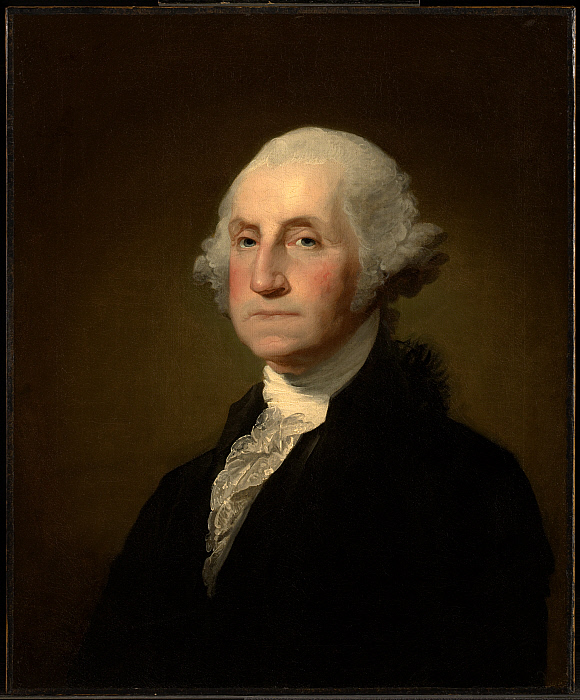
Image Not Available



Zoom
Download
JPEG images are suitable for most presentation uses. TIFF images are suitable for publication purposes. When using images, please reproduce caption and credit information. For details or further information, click here.
If the file does not immediately download, it should open in a new tab. Once opened, right–click the image to save.
Audio
Gilbert Stuart
American, 1755–1828
George Washington
1796–1803
George Washington’s image first became popular in America around 1775, the year he was named commander in chief of the Continental army. Formal yet direct, this portrait is among many variants that Stuart based on his famous, unfinished study of President Washington done from life in 1796. Stuart’s portraits quickly became the iconic representation of Washington as statesman and founding father of the new republic, guaranteeing the artist a long and lucrative career.
Image Caption
Gilbert Stuart, George Washington, 1796–1803, oil on canvas. Clark Art Institute, 1955.16
Medium
oil on canvas
Dimensions
28 15/16 × 24 1/16 in. (73.5 × 61.1 cm)
Frame: 35 7/8 × 30 5/8 × 3 1/4 in. (91.1 × 77.8 × 8.3 cm)
Object Number
1955.16
Acquisition
Acquired by Sterling and Francine Clark before 1955
Status
On View
Select Bibliography
Wood, B. Dan. The Myth of Presidential Representation. Cambridge and New York: Cambridge University Press, 2009. Gustavus Eisen.. Portraits of Washington.. New York: Robert Hamilton and Assoc.. 1912.. Mantle Fielding.. Gilbert Stuart's Portraits of Washington.. Philadelphia: Wickersham Printing Co.. 1923.. John Hill Morgan and Mantle Fielding.. The Life Portraits of George Washington and Their Replicas.. Philadelphia: Privately printed.. 1931.. Sterling and Francine Clark Art Institute. Exhibit Four: First Two Rooms. Exhibition catalogue. Williamstown, MA: Sterling and Francine Clark Art Institute, 1955. Sterling and Francine Clark Art Institute. Exhibit Four & Exhibit Seven. Exhibition catalogue. Williamstown, MA: Sterling and Francine Clark Art Institute, 1958. Charles Merrill Mount.. Gilbert Stuart.. New York: W. W. Norton & Co.. 1964.. Sterling and Francine Clark Art Institute. List of Paintings in the Sterling and Francine Clark Art Institute. Williamstown, MA: Sterling and Francine Clark Art Institute, 1970. Sterling and Francine Clark Art Institute. List of Paintings in the Sterling & Francine Clark Art Institute. Williamstown, MA: Sterling and Francine Clark Art Institute, 1972. Faison, S. Lane, Jr. "Painter of Washington: Gilbert Stuart's $100 Bills." Berkshire Eagle, 22 February 1975. Sterling and Francine Clark Art Institute. List of Paintings in the Sterling and Francine Clark Art Institute. Williamstown, MA: Sterling and Francine Clark Art Institute, 1984. Conrads, Margaret C. American Paintings and Sculpture at the Sterling and Francine Clark Art Institute. New York: Hudson Hills Press, 1990. Kern, Steven, ed. List of Paintings in the Sterling and Francine Clark Art Institute. Williamstown, MA: Sterling and Francine Clark Art Institute, 1992. Williams College Museum of Art.. George Washington. Sept. 5-Nov. 29, 1992. No cat.. 1992.. Richard Wendorf.. Sir Joshua Reynolds: The Painter in Society.. Cambridge (Mass.): Harvard University Press.. 1996.. Koja, Stephan, ed. America: The New World in 19th-Century Painting. Exhibition catalogue. Munich: Prestel, 1999. Barratt, Carrie Rebora and Ellen G. Miles. Gilbert Stuart. Exhibition catalogue. New York: The Metropolitan Museum of Art; New Haven: Yale University Press, 2004. Jolly, Penny Howell. Hair: Untangling a Social History. The Frances Young Tang Teaching Museum and Art Gallery at Skidmore College, January 31 - June 6, 2004. The Frances Young Tang Teaching Museum and Art Gallery at Skidmore College. 2004:plate 34. Conforti, Michael, et al. The Clark Brothers Collect: Impressionist and Early Modern Paintings. Exhibition catalogue. Williamstown, MA: Sterling and Francine Clark Art Institute; New Haven: distributed by Yale University Press, 2006. Davidson, Susan ed. America Today: 300 Years of Art from the U.S.A.. National Art Museum of China, Beijing, February 10- April 5, 2007; Shanghai Museum, April 30- June 30, 2007; Pushkin Museum of Fine Arts, Moscow, July 23- September 9, 2007; Guggenheim Museum Bilbao, October 10, 2007- January 13, 2008. London; New York: Merrell; New York: Guggenheim Museum; Chicago: Terra Foundation for American Art. 2007. Brookhiser, Richard. Washington in His Own Words: Special Collector's Edition from the Editors of American History Magazine (2010). Ganz, James A. and Richard R. Brettell. Great French Paintings from the Clark: Barbizon through Impressionism. Exhibition catalogue. New York: Skira Rizzoli Publications; Williamstown, MA: Sterling and Francine Clark Art Institute, 2011.
Provenance
William Willing by 1845; to (Lewis Rogers, agent, New York, 1845); to R.L. Paterson, 1845; to Charles Paterson, by descent; to (Hermann Schaus?); to Mrs. Elizabeth S. Clark, c. 1905; to Stephen C. Clark, by descent, 1909; to Robert Sterling Clark by April 1911.