
Shop
Museum
Overview
Exhibitions


Collections
Education
Publications
Clark Connects
Art on the Grounds
Study Center
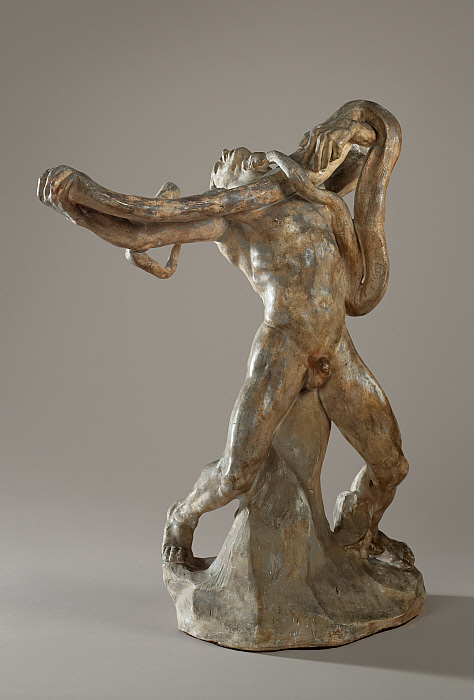
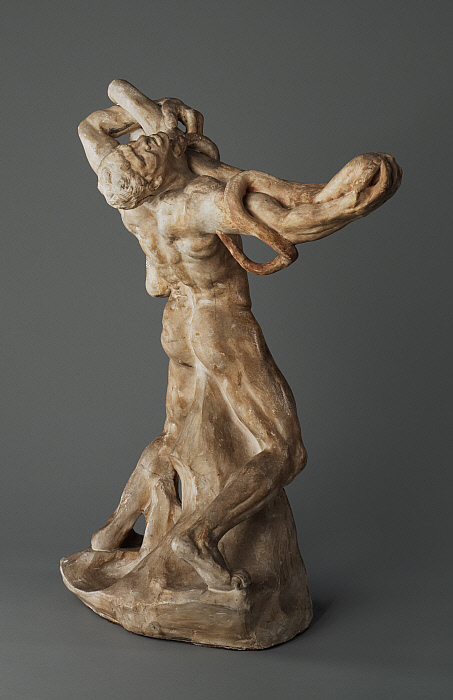
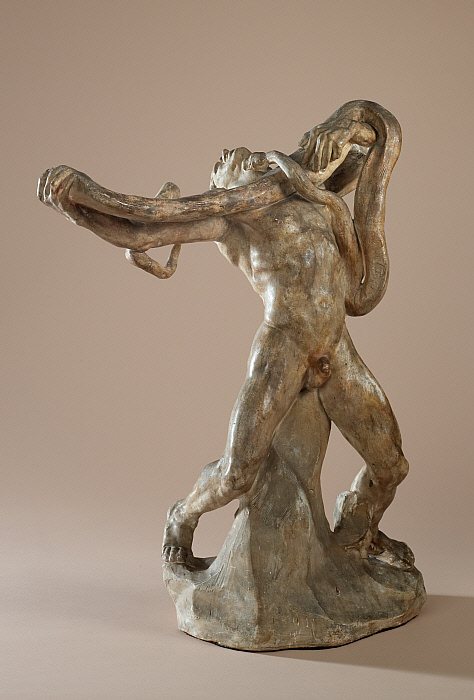
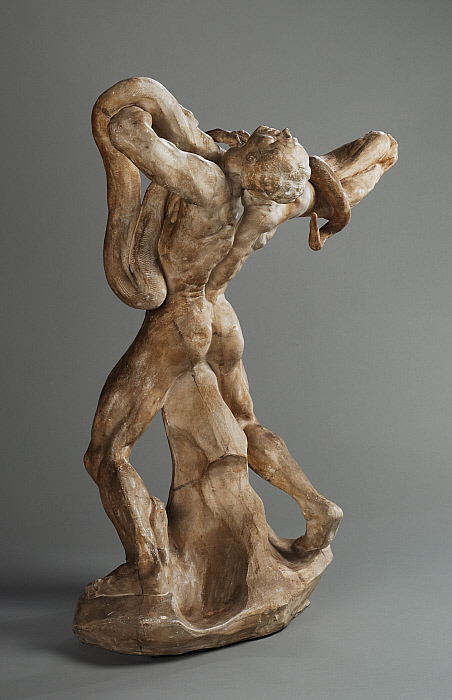
Image Not Available




Zoom
Download
JPEG images are suitable for most presentation uses. TIFF images are suitable for publication purposes. When using images, please reproduce caption and credit information. For details or further information, click here.
If the file does not immediately download, it should open in a new tab. Once opened, right–click the image to save.
Audio
Auguste Rodin
French, 1840–1917
Man with Serpent
1885
When this sculpture is viewed from the front, the outcome of the struggle is uncertain. Only from the side can we see the serpent delivering a fatal bite to the man’s neck. The man’s pose was adapted, at the request of a collector, from that of a falling figure in a monumental sculpture on which Rodin worked for 37 years but never finished—the Gates of Hell. Plaster casts like this one were an important part of the process of transforming a clay model into a finished bronze.
Image Caption
Auguste Rodin, Man with Serpent, 1885, plaster. Clark Art Institute, 1955.1023
Medium
plaster
Dimensions
27 1/2 × 22 × 11 7/8 in. (69.9 × 55.9 × 30.2 cm)
Object Number
1955.1023
Acquisition
Acquired by Sterling and Francine Clark before 1955
Status
On View
Select Bibliography
Sterling and Francine Clark Art Institute. Exhibit Five, Supplement: South Gallery. Exhibition catalogue. Williamstown, MA: Sterling and Francine Clark Art Institute, 1959. John L. Tancock.. The Sculpture of Auguste Rodin: The Collection of the Rodin Museum, Philadelphia.. Philadelphia: Philadelphia Museum of Art.. 1976.. Lovett, Jennifer Gordon. The Art and Craft of Nineteenth-Century Sculpture. Williamstown, MA: Sterling and Francine Clark Art Institute, 1994. Conforti, Michael, et al. The Clark Brothers Collect: Impressionist and Early Modern Paintings. Exhibition catalogue. Williamstown, MA: Sterling and Francine Clark Art Institute; New Haven: distributed by Yale University Press, 2006. Ganz, James A. and Richard R. Brettell. Great French Paintings from the Clark: Barbizon through Impressionism. Exhibition catalogue. New York: Skira Rizzoli Publications; Williamstown, MA: Sterling and Francine Clark Art Institute, 2011.
Provenance
Antony Roux (1833–1913), Marseille, Monte-Carlo, Paris (1887–1914, his sale, Paris, May 19–20, 1914, no. 146, sold to M. Knoedler, agent for Robert Sterling Clark, who purchased for his brother, Stephen Clark); Stephen Carleton Clark (1882–1960), New York and Cooperstown, New York (1914–23, consigned to Knoedler’s); Robert Sterling Clark (1877–1956), New York (1923–55, given to museum); Sterling and Francine Clark Art Institute, Williamstown, 1955.